In Defense of Dijon
My father made my school lunches. Pimento loaf on homemade bread — or sourdough from La Boulangerie, the bakery down the street that I loved for after-school snacks and resented on sandwich days — grey poupon, a piece of fruit. While other kids unwrapped turkey and Kraft Singles on Wonderbread with Heinz yellow mustard, I sat across from my lunch feeling like I’d been sent from a different country. Which, in a way, I had.
I wanted the Wonderbread desperately. The other kids had New Kids on the Block on the bag. I had sourdough.
We never had Kraft Singles in our house. My parents refused on the basis that it wasn’t real cheese. I wanted to fit in. I did not fit in.
What I didn’t understand then, eating my pimento loaf sandwich and wishing for normalcy, was that my father was teaching me something. Not about mustard specifically — though grey poupon would turn out to be the beginning of a long education — but about the idea that food has standards. That what goes in your mouth matters. That the difference between a good thing and a cheap imitation is worth defending even when nobody else at the lunch table understands it yet.
I’ve been defending Dijon ever since.
In a kitchen, Dijon does several things at once. It emulsifies — the thing that holds a vinaigrette together, that keeps the oil and vinegar from separating back into themselves. It adds acid and heat without overwhelming. It builds depth in a sauce, rounds out a dressing, rescues a broken emulsion. My mother made a few simple things in the kitchen, one being Dijon vinaigrette. Oil, vinegar, Dijon, salt. When she dressed the salad, it was perfect every time. I didn’t know she was teaching me technique. I didn’t know I was learning it.
I know now. I put Dijon in everything. The lentils, the yogurt sauce, the vinaigrette. It’s in the haricots verts, in the potato sauce, in the thing I make when I’m not sure what’s missing — and something is always missing until I add it. A tablespoon and a half sounds like a lot. It never is.
This is a dinner built around that principle. Three simple dishes, one table, Dijon running through all of it like a thread.
My father made lentils with sausage. I make them with Dijon. Some things stay, some things change. The lentils stayed. Turns out my parents were right about the cheese.
Simple French Lentils with Dijon
The simplest French lentils — cooked low and slow with aromatic vegetables, finished with a generous spoonful of Dijon.
Ingredients
1 cup French green lentils (Puy)
2½ cups water
1 carrot, snapped in half, unpeeled
½ onion, peeled, studded with 2 whole cloves
2 garlic cloves, halved
1 bay leaf
1½ tbsp Dijon mustard
Fine sea salt to taste
Method
— Combine. Rinse the lentils and place in a pot with the water, carrot, clove-studded onion, garlic, and bay leaf. Season with salt. Bring to a boil over medium-high heat.
— Simmer. Reduce heat to a gentle simmer, cover, and cook until the lentils are tender but still holding their shape, about 25–30 minutes. Check occasionally and add a splash of water if needed — the lentils should be just covered throughout.
— Finish with Dijon. Remove and discard the carrot, onion, garlic, and bay leaf. Taste for salt. Remove from heat and stir in the Dijon. The residual heat will bloom the mustard without cooking off its sharpness.
— Serve warm alongside crispy potatoes, haricots verts, or anything else on the table that deserves them.
Cook’s Notes
On the lentils: French green lentils or Puy lentils only — they hold their shape and have a peppery, earthy quality that suits this dish. Brown lentils will turn to mush here — save them for dal or mujaddara, two other favorites in my home kitchen.
On the aromatics: The carrot, onion piqué, garlic, and bay leaf are removed before serving — they’re there to build depth, not to be eaten. Don’t skip them.
On the Dijon: Stir it in off the heat at the end. A tablespoon and a half sounds like a lot. It isn’t. This is the point of the dish.
On leftovers: These lentils are better the next day. The Dijon mellows and everything comes together. Eat them cold with a little olive oil, or reheat gently with a splash of water.
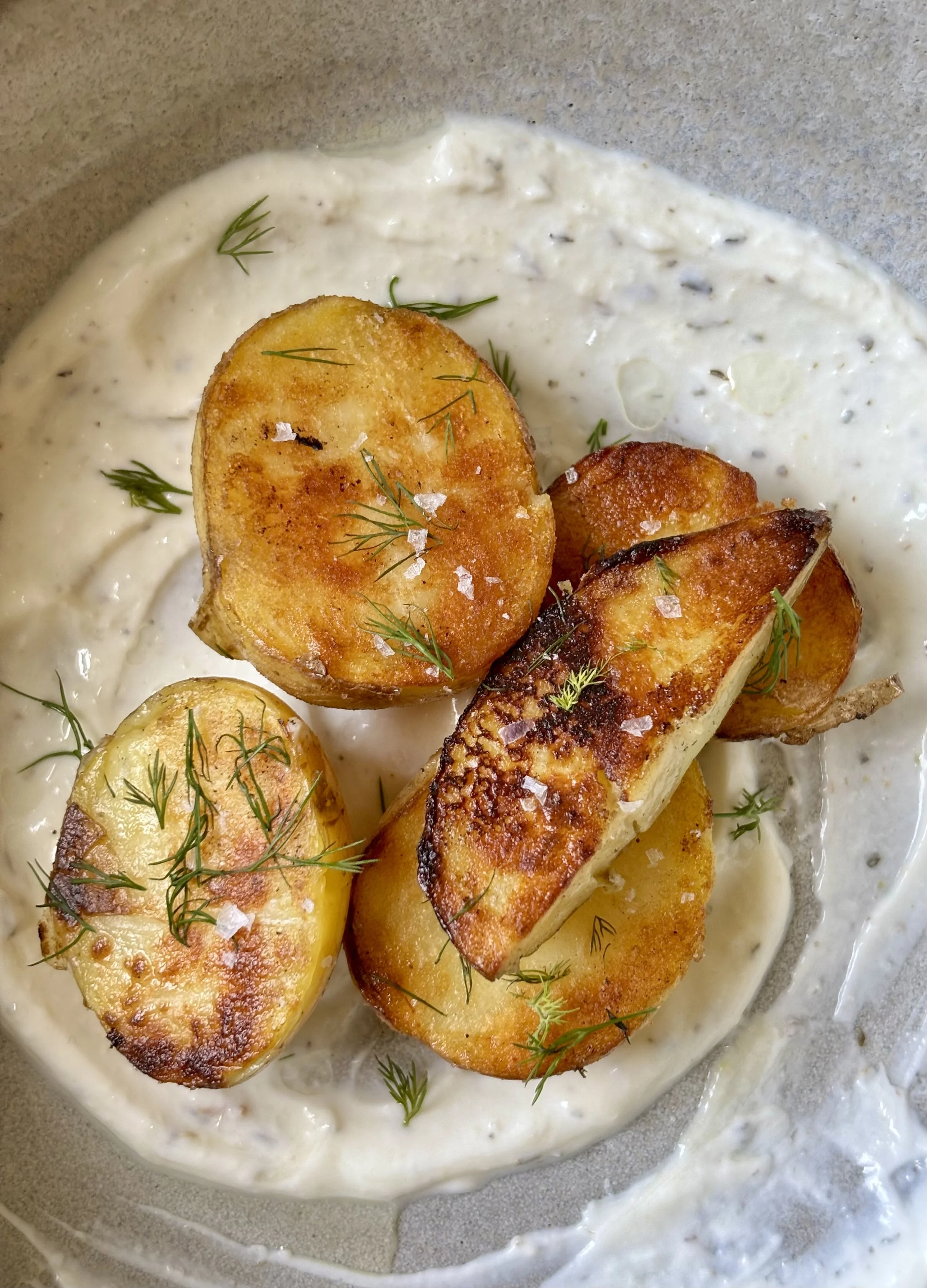
Crispy Cast Iron Potatoes with Herbes de Provence Yogurt
Crispy cast iron potatoes on a bed of herby yogurt sauce — simple, rustic, and deeply satisfying. Make the haricots verts alongside and use the shallot oil here. Nothing wasted.
Ingredients
— For the potatoes:
1 lb baby Yukon gold or fingerling potatoes
1 tbsp shallot oil, reserved from the crispy shallots
Fine sea salt to taste
— For the yogurt sauce:
⅓ cup full fat Greek yogurt, room temperature
1 garlic clove, minced
Juice of ½ lemon
½ tsp Dijon mustard
2½ tsp herbes de Provence
Fine sea salt to taste
— To finish:
Fresh dill sprigs
Maldon
Method
— Boil the potatoes. Place the potatoes in a large pot of heavily salted cold water. Bring to a boil and cook until completely tender when pierced with a knife, about 25–30 minutes. Drain well and let steam dry for a few minutes. Cut in half.
— Make the yogurt sauce. Combine the minced garlic with the lemon juice in a small bowl. Let macerate for 10 minutes. Add the yogurt, Dijon, and herbes de Provence. Season with salt to taste. Set aside at room temperature.
— Fry the potatoes. Heat the shallot oil in a cast iron skillet over medium-high heat. Place the potatoes cut side down and leave them alone until deeply golden and crisp, about 4–5 minutes. Season with salt as they fry, spooning any remaining oil over the tops.
— Plate. Spoon the yogurt sauce onto a plate or shallow bowl, spreading it to the edges. Pile the hot crispy potatoes on top, cut side up. Finish with fresh dill sprigs and a generous pinch of Maldon.
Cook’s Notes
On the shallot oil: This dish is designed to be made alongside the haricots verts — the reserved frying oil is the secret. If you don’t have shallot oil, a neutral oil works fine but you’ll miss something.
On the garlic: Macerating the minced garlic in lemon juice for 10 minutes mellows its sharpness without cooking it. Don’t skip this step.
On the yogurt: Full fat, room temperature. Cold yogurt on a hot potato is a missed opportunity.
On the herbes de Provence: It should show up. 2½ teaspoons in a small sauce sounds like a lot — it isn’t. This is the flavor of the dish.
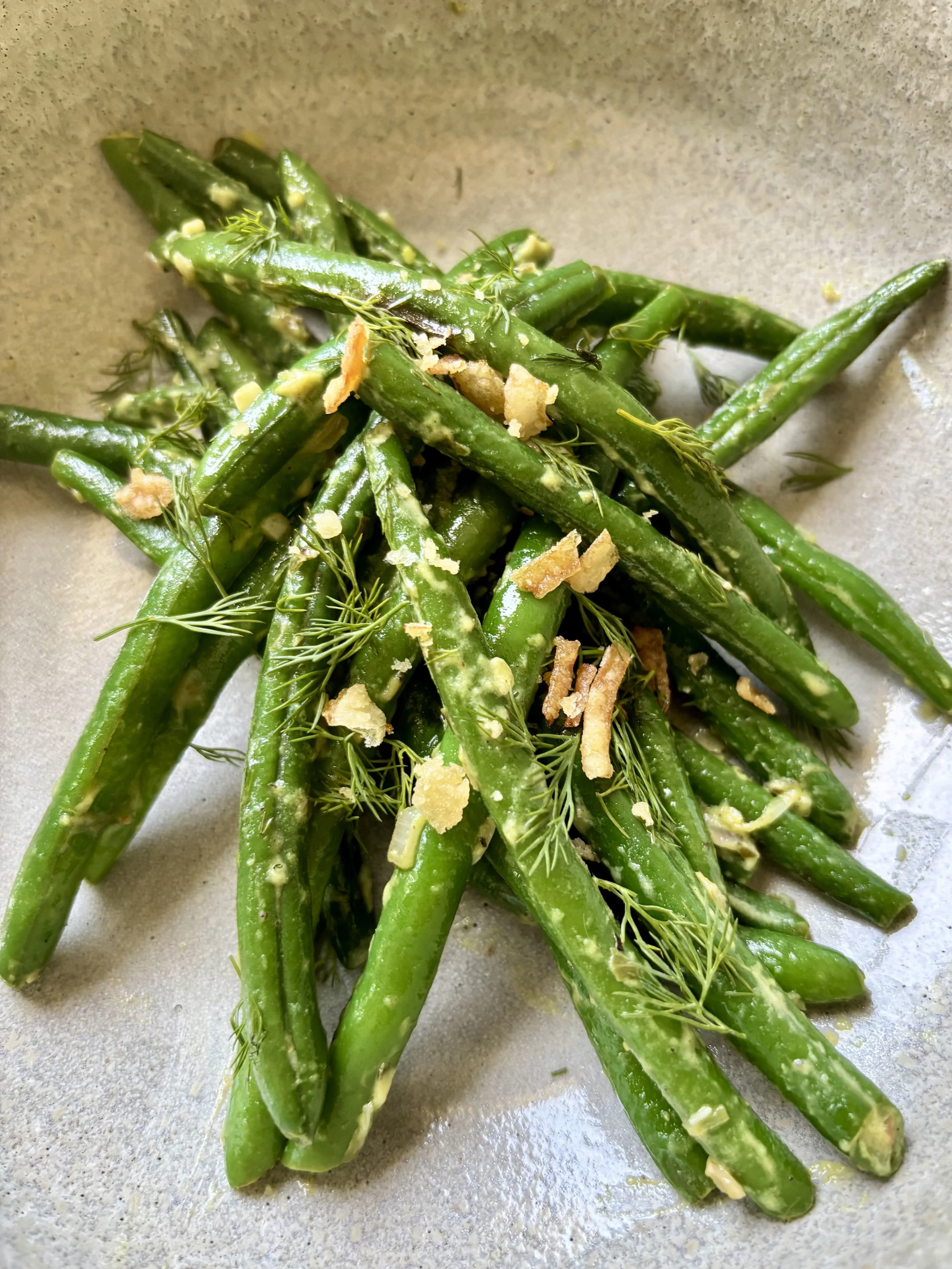
Haricots Verts with Dill and Crispy Shallots
Blanched bright and tender, finished in butter and topped with fresh dill and shatteringly crispy fried shallots.
Ingredients
16 oz haricots verts (thin French green beans)
3 shallots, thinly sliced into rings
½ cup neutral oil, for frying
2 tbsp unsalted butter
2 garlic cloves, minced
1 tsp Dijon mustard
1 tbsp fresh lemon juice
1 tsp fine sea salt
¼ tsp black pepper
3 tbsp fresh dill, picked into sprigs
Method
— Fry the shallots. Heat the neutral oil in a small saucepan over medium heat. Add the shallots and fry, stirring occasionally, until golden and crisp. Remove with a slotted spoon to a paper towel-lined plate and season immediately with a pinch of salt. Reserve the shallot oil.
— Prepare. Bring a large pot of heavily salted water to a boil. Prepare an ice bath in a large bowl.
— Blanch and shock. Add the haricots verts to the boiling water and cook until just tender-crisp and vivid green. Immediately transfer to the ice bath to stop cooking. Once cold, drain well and pat dry.
— Finish the beans. Melt the butter in a large skillet over medium heat. Add the garlic and cook 30 seconds until fragrant, then stir in the Dijon. Add the beans and toss to coat, cooking until heated through, 1–2 minutes. Add the lemon juice, salt, and black pepper. Taste and adjust seasoning.
— Plate. Transfer to a platter. Scatter the dill over the top — no knife needed, just pull small sprigs directly from the stem — then pile on the crispy shallots. Serve immediately.
Cooks’s Notes
Crispy shallot tip: Pull them from the oil when they’re just golden — they’ll continue to darken as they drain. Wait too long and they turn bitter.
Save the shallot oil: Don’t discard the frying oil — it’s deeply savory and wonderful. Strain it through a fine mesh sieve, let it cool, and store in a jar in the fridge for up to 2 weeks. Use it for sautéing vegetables, dressing grains, or anywhere you’d use a finishing oil.
Make-ahead: Crispy shallots can be made hours ahead and held at room temp on a paper towel. Beans can be blanched and shocked up to a day ahead.
