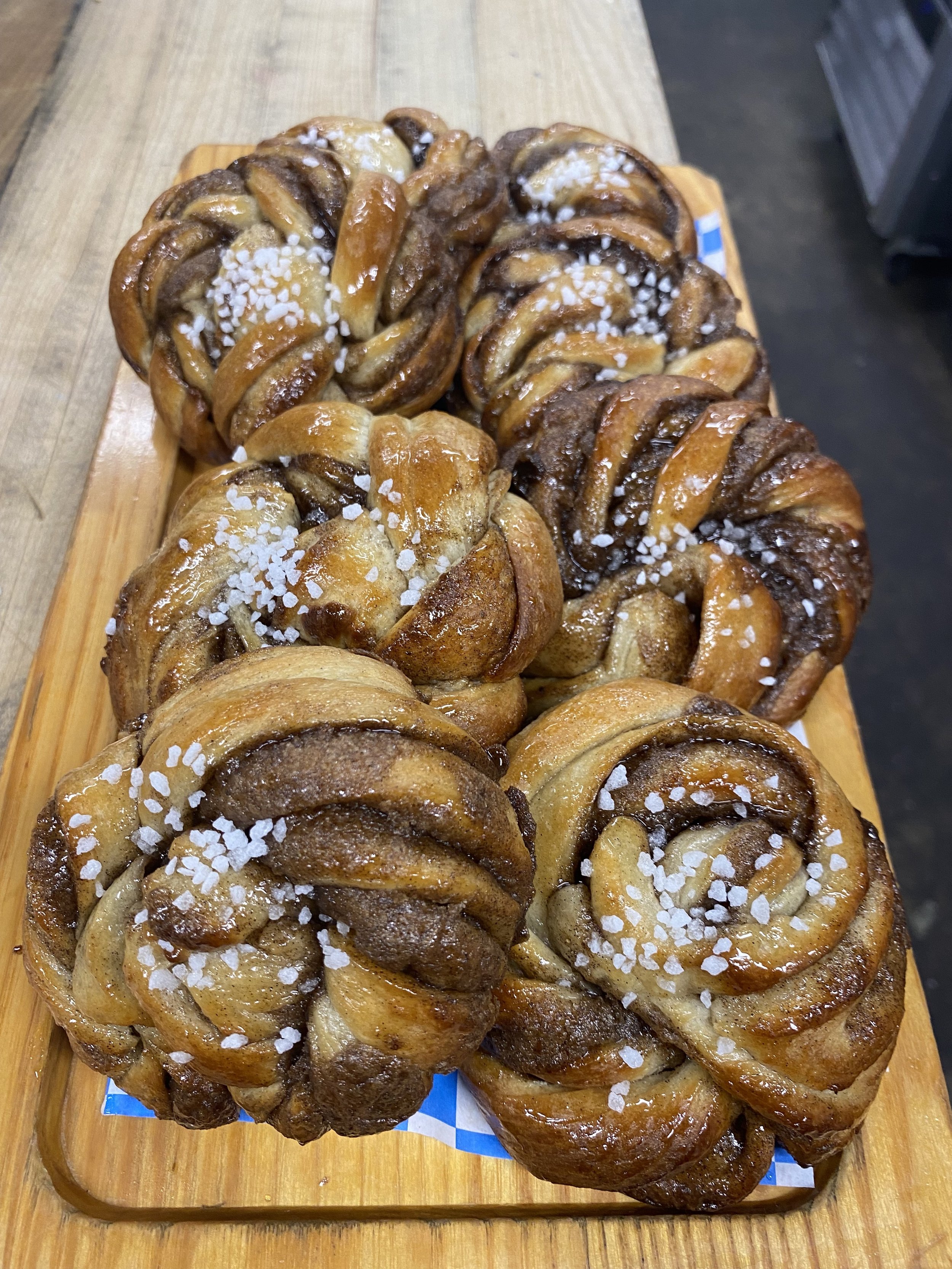
A popular Scandinavian daytime café came to me with a request: build a fika program. Authentic, Scandinavian, the real thing.
I knew fika the way most Americans do — vaguely, through the meatball cafeteria in a furniture store, otherwise known as Ikea. Coffee. Something sweet. A pause. I knew it wasn't just a snack but I couldn't have told you why it mattered.
So I did what any self-respecting baker does when handed an assignment: I ate my way through the research. A small Scandinavian café in San Francisco. Cookbooks. Late nights on the internet. I came away with a cardamom bun recipe and something more useful — an understanding of what fika actually is.
It isn't about the bun.
Fika is not a coffee break. A coffee break is something you take at your desk, alone, scrolling your phone for seven minutes before going back to whatever you were doing. Fika is intentional. It is a scheduled slowing down — a moment built into the day to remember what actually matters: community, connection, good food, rest. In Sweden it is so embedded in workplace culture that skipping it is considered antisocial. You don't opt out of fika. You show up.
I'd seen something similar in Munich years before I had a word for it. February, cold enough that the cafes had their windows half-open anyway, because the cold air is as familiar here as the ritual. At four o'clock, without any apparent coordination, everyone stopped. The older women especially — they arrived in pairs or with their families, and settled in with the unhurried certainty of people who have earned their afternoon. A slice of something with chocolate, or marzipan, or custard, or cream. The conversation was warm and unhurried. Nobody was in a rush to be anywhere else.
I was alone, exploring the city. I sat down and ordered what they were having. It was the best four o'clock I'd ever spent.
Every culture has a version of this. Sweden calls it fika. Germany calls it Kaffee und Kuchen. France calls it goûter — the four o'clock snack, the children's ritual that adults quietly never gave up. In India, chai arrives at the same hour — spiced, milky, essential. The names are different but the intention is the same: slow down. Appreciate what matters. Be sweet to ourselves, literally and otherwise. It is not indulgence. It is maintenance. The cultures that understand this build it into the day like infrastructure — not something you earn, but something you simply do.
In September I'll be in Paris. I don't know yet what four o'clock will look like there — maybe a café, maybe a bench, maybe Jenny and I eating chocolate and bread like Parisian school children. Maybe Bret's chips, which are frankly reason enough to go.
What I know is that I'll stop. I'll sit down. I'll let the afternoon do what afternoons are supposed to do.
Until then — a cardamom bun and a cup of coffee. It's four o'clock somewhere.
Kardemummabullar (Swedish Cardamom Buns)
Swedish cardamom buns made with a tangzhong — a Japanese flour paste technique that keeps the crumb impossibly soft for days. A Swedish ritual, a Japanese secret.
Ingredients
For the tangzhong:
38g bread flour
170g whole milk
For the dough:
115g whole milk
312g bread flour
12g instant yeast
50g sugar
7g fine sea salt
85g unsalted butter, softened
4g ground cardamom
For the filling:
75g sugar
85g unsalted butter, softened
1 tbsp bread flour
4g fine sea salt
18g ground cardamom
2g ground cinnamon
1 tsp black cocoa powder
1 tsp black pepper
To finish:
1 egg, for egg wash
2 tbsp pearl sugar
50g sugar, for syrup
50g water, for syrup
Method
Make the tangzhong. Whisk the bread flour and milk together in a small saucepan over medium heat, whisking every 20 seconds, until the mixture thickens to a stiff paste, 1 to 2 minutes. Remove from heat and set aside.
Make the dough. In the bowl of a stand mixer, whisk the tangzhong with the milk until smooth. Add the bread flour and yeast. Fit the mixer with the dough hook and mix on low speed until all flour is moistened, 1 to 2 minutes — the dough will look quite dry. Let stand for 15 minutes.
Develop the dough. Add the sugar and salt and mix on medium-low for 5 minutes. Stop the mixer and add the butter and cardamom. Continue mixing on medium-low for 5 minutes longer, scraping down the hook and sides halfway through. The dough may stick to the bottom but should clear the sides. Cover and refrigerate for 1 hour.
Make the filling. Add all filling ingredients to a mixer fitted with the paddle. Mix on low until fully combined, about 1 minute. Set aside.
Fill and fold. Roll the dough into an 18 by 10-inch rectangle with the shorter side parallel to the edge of the counter. Spread the filling over the lower two-thirds of the rectangle, going all the way to the edges. Fold the upper third over the middle third, then fold the lower third over to create a 6 by 10-inch rectangle. Roll into a 12-inch square. Cut into twelve 1-inch strips.
Shape the knots. Take one strip and wrap it around two fingers. Bring the tail under and pull it through the middle to form a knot. Place on a parchment-lined baking sheet. Repeat with remaining strips. Let rise until slightly puffed, about 1 hour.
Bake. Preheat oven to 425°F. Brush each bun with egg wash and sprinkle generously with pearl sugar. Bake on the middle rack until golden brown and the internal temperature reaches at least 200°F, 13 to 17 minutes, rotating the sheet halfway through.
Glaze. While the buns bake, combine the sugar and water in a small saucepan over medium heat and stir until the sugar dissolves. As soon as the buns come out of the oven, brush generously with the sugar syrup. Transfer to a wire rack. Best eaten warm.
Baker's Notes
On the tangzhong: This Japanese technique — cooking a small amount of flour in milk before adding it to the dough — gelatinizes the starches and traps moisture, keeping the crumb impossibly soft for days. It's the secret behind Japanese milk bread and, as it turns out, the best cardamom buns you'll ever make.
On the cardamom: Use freshly ground if you can. The filling uses a generous amount — 18g — which sounds like a lot. It isn't. This is the flavor of the bun.
On the shaping: The knot takes a few tries to feel natural. Wrap the strip around two fingers, bring the tail under, pull through the middle. Don't overthink it — even imperfect knots bake beautifully.
On the glaze: Don't skip it. The sugar syrup applied hot from the oven is what gives these their signature lacquered finish.
Storage: These freeze beautifully unbaked. After shaping, place the knots on a parchment-lined sheet and freeze until solid, then transfer to a zip-lock bag. Bake from frozen at 425°F, adding a few extra minutes. Bake only what you need — a fresh cardamom bun is always better than a reheated one.
