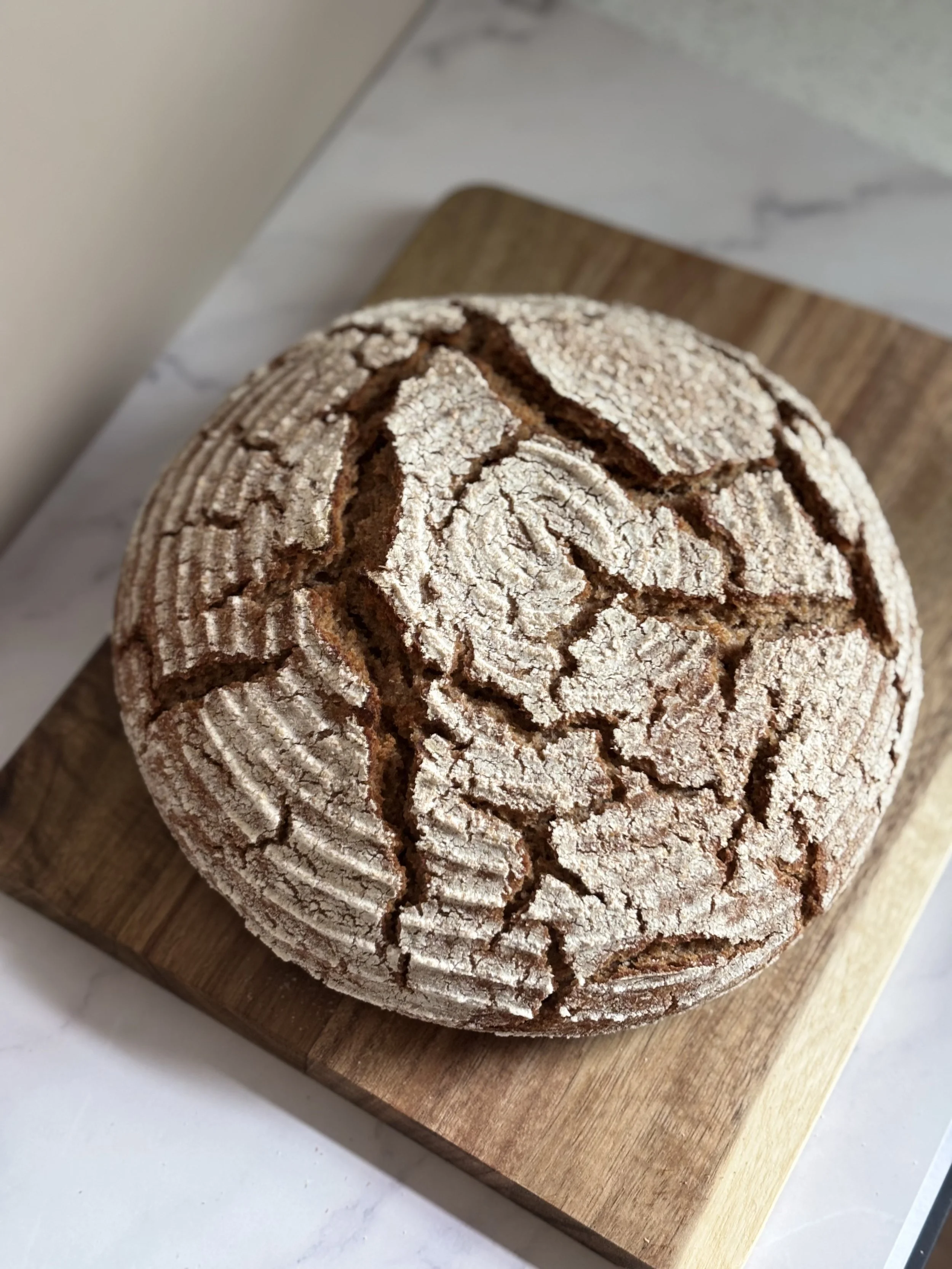
Pain de Campagne
The word lord comes from the Old English hlaford — loaf guardian. Lady from hlæfdige — loaf kneader. Before bread was comfort food or craft hobby or Instagram aesthetic, it was survival. It was importance.
I think about that sometimes when I'm standing at my counter in the early morning, checking on my starter before the coffee has finished brewing. There's something in the act that feels older than my kitchen, older than me. Bread has always required this — someone paying attention, someone showing up.
I learned to make sourdough not at home but at work, in a professional bakery, where the starter had a name. She was called Happy. Happy was fed on a schedule, kept at a precise temperature, and checked on with the kind of attentiveness you'd give a living thing — which is exactly what she was. What I learned from Happy, more than any technique, was how to read her.
Sourdough has three states, and knowing them is everything. There's the active stage — bubbly, domed, doubled in size, ready and willing. There's the sleeping stage that follows, when the activity slows and the starter settles. And then there's hungry — when it's burned through all its food and started producing hooch, that thin layer of liquid that pools on top like a small protest. A hungry starter isn't a dead one. It just needs feeding.
Most beginner sourdough guides will give you timelines. Feed every twelve hours. Use after four to six hours. Bake on day three. Those timelines are useful starting points, but they're not the whole story. Temperature, hydration, the particular personality of your starter — all of it shifts the schedule. What you're really learning, underneath the recipe, is to pay attention. To look, smell, and eventually just know.
That's the thing nobody tells you about sourdough: it isn't difficult. It's slow. The hands-on work is maybe twenty minutes spread across two days. What it asks of you is presence, not labor. Check in. Adjust. Let it tell you what it needs.
Give it time.
Pain de Campagne—Rustic Country Sourdough
A straightforward beginner sourdough with real flavor. No levain, no complicated steps — just a well-fed starter, good flour, and time.
Ingredients
400g bread flour
100g dark rye flour
375g water, room temperature
100g active sourdough starter
10g fine sea salt
Method
Feed your starter. Feed your starter 4–8 hours before mixing. It's ready to use when it's domed, bubbly, and active — what I call the happy stage. If it's flat or has liquid pooling on top, it needs more time or another feeding.
Mix. Whisk the starter into the water until fully dissolved. Add the bread flour, dark rye flour, and salt. Mix until no dry flour remains. Cover and rest for 30 minutes.
Stretch and fold. Over the next 2 hours, perform 4 sets of stretch and folds, spaced 30 minutes apart. To stretch and fold: grab one side of the dough, stretch it up and fold it over the center. Rotate the bowl and repeat all four sides. Cover between sets.
Bulk fermentation. After the final fold, leave the dough to bulk ferment at room temperature until it has grown by about 50–75%, feels airy, and jiggles when you shake the bowl. With dark rye in the mix, this can move faster than you expect — start checking at the 3 hour mark. Trust what you see over the clock.
Shape. Turn the dough out onto an unfloured surface. Using a bench scraper, shape it into a tight round by dragging it toward you to build surface tension. Let it rest uncovered for 20 minutes, then do a final shape and place it seam-side up into a well-floured banneton or a bowl lined with a floured kitchen towel.
Cold retard. Cover the banneton with a plastic bag or shower cap and place in the refrigerator overnight, or up to 16 hours. The cold slows fermentation and develops flavor. It also makes the dough easier to score.
Bake. Place a dutch oven in your oven and preheat to 500°F (260°C) for at least 45 minutes. When ready, turn the dough out onto a piece of parchment, score the top with a sharp knife or lame, and carefully lower it into the hot dutch oven. Bake covered for 20 minutes, then remove the lid and bake for another 20–25 minutes until deep golden brown. Cool on a wire rack for at least one hour before cutting.
Baker's Notes
On reading your starter: Before you mix, make sure your starter is at peak activity — domed, bubbly, and doubled in size. Drop a small spoonful into water; if it floats, it's ready. If it sinks, give it more time.
On rye: Dark rye ferments faster than whole wheat — keep an eye on your bulk fermentation, especially in a warm kitchen. It may move quicker than you expect.
On hydration: 75% is a good beginner hydration. If the dough feels unmanageable, reduce water by 25g next time.
On timing: Sourdough doesn't run on a clock, it runs on temperature and activity. A cooler kitchen means longer fermentation. Trust the dough over the timer.
